.png)
32 NHL Cities in 32 Days: Chicago Blackhawks
- Alexis Bazydola

- May 7, 2020
- 6 min read
The Location: Chicago, Illinois

The United Center is the home of both the Chicago Blackhawks and the Chicago Bulls. The largest arena in the United States was officially opened in 1994. It hosts over 200 events per year with events like the 1996 Democratic National Convention, Paul McCartney, U2, The Rolling Stones and Eric Clapton being just a few of those that have appeared at the arena over the years. In the 2017-18 NHLPA Player Poll, the United Center came in second as the players’ favorite rink to play in.
Team History

The Chicago Black Hawks were founded in 1926. Their name originated from owner Frederic McLaughlin. He had been a commander with the 333rd Machine Gun Battalion of the 86th Infantry Division during World War I which was nicknamed the “Blackhawk Division.” It became one of the many franchises to utilize Native Americans as icons. Unlike the nickname, Black Hawks was spelled in two words until the 1980s. This original team became the first in the NHL to have an all-American born roster.
The Black Hawks began play in November 1926 at the Chicago Coliseum. While they found regular season success in their first season, they could not convert this to playoff success and were defeated in the first round by the Boston Bruins. The 1928-29 season saw the Black Hawks split time between three arenas: the Chicago Coliseum, the Detroit Olympia and the Peace Bridge Arena. They finally moved to Chicago Stadium the following season.
After being defeated by the Montreal Canadians in 1931 for the Stanley Cup, the Hawks won their first Stanley Cup after defeating the Detroit Red Wings in 1934. A second championship came to the team in 1938 as they beat the Toronto Maple Leafs. After this, the team hit a slump due to ownership disputes following McLaughlin’s death as Detroit Red Wings owner James E. Norris (who owned the Chicago Stadium) played puppet master over the team. Between 1945-1958, the Black Hawks would only make the playoffs twice.
The late 1950s saw standout stars make their way to the Chicago roster: Bobby Hull, Stan Mikita, Pierre Pilote, Glenn Hall and Ted Lindsay. As the 60s brought two more Finals appearances for the Hawks, they could not capitalize and fell to the Toronto Maple Leafs in 1962 and Montreal Canadiens in 1965. Although they had strong scoring cores and defensive superstars, they could not put the puzzle pieces together fully.

The 1970s saw change for the Hawks through moving to the West Division, various trades, losing players to the World Hockey Association (WHA) and ownership changes. Despite all of this, they made the playoffs each year and won seven division championships throughout the decade.
The 80s saw the continue fall of Blackhawk success, but the 1992 Stanley Cup Final saw that change. After winning the Presidents’ Trophy during the 1990-91 season, the team was knocked out of the playoffs by the Minnesota North Stars in the first round. Finally, in 1992 the team reached the Finals for the first time in 19 years. They won 11 consecutive playoff games that year setting an NHL record. Despite this success, the Pittsburgh Penguins swept the Hawks in the Finals. Although they made the playoffs over the next few seasons, they could not again find the success they had in the past.
For the first time in 29 years, the Blackhawks missed the playoffs in 1998. They would then miss the playoffs for the next three seasons. February 2004 brought a painful title to the Hawks franchise via ESPN: “the worst franchise in sports.” Following the lockout, new General Manager Dale Tallon looked to rebuild the struggling franchise. He signed free agent contracts with Nikolai Khabibulin and Adrian Aucoin. Both were injured throughout the season and the Blackhawks missed the playoffs, yet again.

The 2006 NHL Entry Draft brought Jonathan Toews to the team. While continuing to try to stack their roster, the team was plagued with injury and consistently fell short in the standings. With this lackluster play came higher draft picks and the selection of Patrick Kane in the 2007 NHL Draft.
Beginning in 2007, the team began to rebuild their front office. With these changes brought better marketing efforts and a better relationship with fans. Rebuilding the roster came next. Both Kane and Toews were finalist for the Calder Memorial Trophy that year with the award going to Kane. The 2007-08 season was better, but the Hawks still missed the playoffs by three points. In October 2008, Joel Quenneville became the head coach. For the first time since the 01-02 season, the Blackhawks were able to clinch a playoff spot. They were able to make it to the Western Conference Finals that year, but ultimately fell to the Detroit Red Wings in five games.
The 2009-10 season was invigorated with stunning fan attendance and by signing Marian Hossa to a 12-year $62.8 million contract prior to the start of the season. Stan Bowman became general manager that year as well. Kane, Toews and Duncan Keith all signed contract extensions in December 2009. After beating the Nashville Predators, then the Vancouver Canucks and sweeping the San Jose Sharks, the Hawks would go on to compete for another Stanley Cup title. They took the series against the Philadelphia Flyers where they would win their first Cup in 49 years and the fourth championship for the team.

The next season was met with salary cap constraints forcing the team to trade much of the talent from the previous season. While they still made the playoffs, they were eliminated by the Vancouver Canucks in seven games. The next season also saw the elimination of the Hawks in the first round by the Phoenix Coyotes. Although the 2012-13 season was shortened due to a lockout, the team would win the Presidents’ Trophy that year. After hard fought battles against the Minnesota Wild, Detroit Red Wings, and LA Kings, they would return to the Stanley Cup Finals for the second time in four seasons. The Hawks would go on to take the series to six games and defeat the Boston Bruins. While they went in to the next season looking to win a second consecutive Cup, they were defeated by the LA Kings in the Western Conference Finals.
The 2014-15 season saw the team make another Stanley Cup Final appearance after besting the Nashville Predators, Minnesota Wild and Anaheim Ducks. The team would face the Tampa Bay Lightning and win their third cup in six seasons. Following this season, the team was forced to make more hard salary cap decisions by letting go many of their top players. The next few years the team would struggle to find success in the playoffs and eventually in the regular season as well. Quenneville would be fired in November 2018 as a result of the poor play with Jeremy Colliton being named as his replacement. Currently at the pause, the Hawks are 23rd in the league with 72 points.
Fanbase

One fan tradition that Blackhawks fans are known for is their National Anthem behavior. They get LOUD throughout the duration of the anthem. It’s no secret that this atmosphere begins with the anthem. Players across the NHL agree and in the 2018-19 NHLPA Player Poll, the United Center was voted as the fourth best atmosphere to play in. In the 2017-18 poll, the players voted the Blackhawks as having the best fans in the league.
Their mascot, Tommy Hawk was introduced in the 01-02 season. He was inducted in to the Mascot Hall of Fame in 2019.
The official fight song of the team is “Here Come the Hawks!” which can be heard throughout the games. “Chelsea Dagger” by the Fratellis is their official goal song and has been used since the 08-09 season. There are also dedicated goal songs to some individual players: “Rock You Like a Hurricane” for Patrick Kane and “Johnny B. Goode” for Jonathan Toews. The Blackhawks were also the first NHL team to sound a goal horn when they scored a goal at home.
Notable Players
Tony Esposito

Years with Chicago: 1969-1984
Jonathan Toews
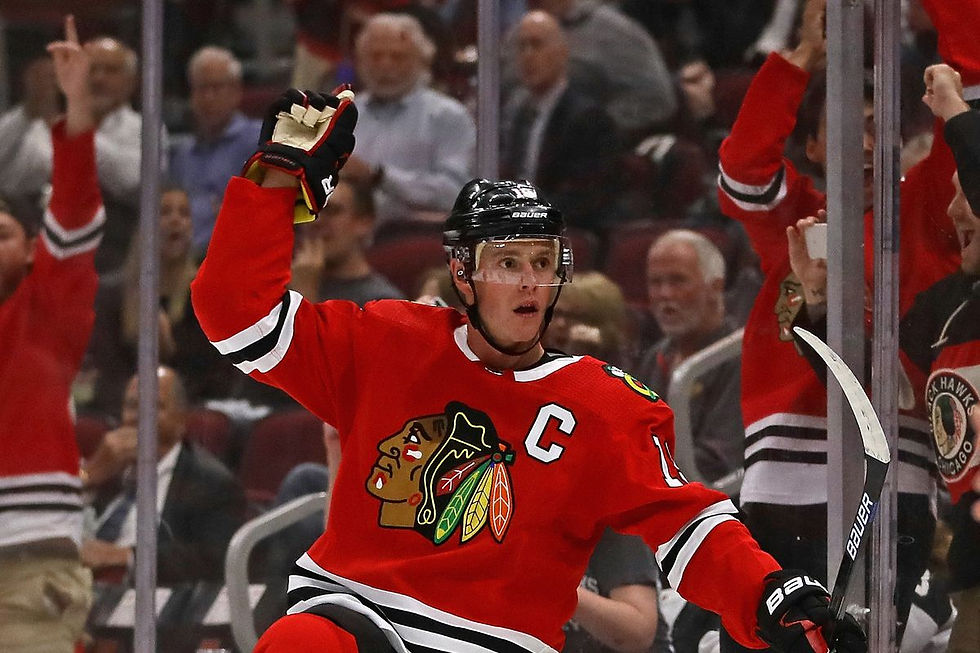
Drafted: Round 1, #3 in 2006 by Chicago Blackhawks
Years with Chicago: 2007-present
Chris Chelios

Years with Chicago: 1990-1999
Denis Savard

Drafted: Round 1, #3 in 1980 by Chicago Blackhawks
Years with Chicago: 1980-1990, 1995-1997
Stan Mikita

Years with Chicago: 1958-1980
Bobby Hull

Years with Chicago: 1957-1972
Patrick Kane

Drafted: Round 1, #1 in 2007 by Chicago Blackhawks
Years with Chicago: 2007-present


Comments